
Candlestick Charts Explained Simply
If you’ve ever opened a trading chart for the first time, you probably had the same reaction most beginners do:
“What am I even looking at?”
A screen full of red and green bars moving up and down can feel overwhelming. Many beginners assume traders must memorize hundreds of patterns or use complicated math to understand markets.
The truth is much simpler.
Candlestick charts are just a visual way of showing a battle between buyers and sellers. Once you understand what each candle represents, trading charts start to feel less like code and more like a story unfolding in real time.
This guide breaks down candlestick charts for beginners in plain language — no jargon, no unnecessary complexity.
What Are Candlestick Charts in Trading?
At their core, candlestick charts are a way to show how price moves over time.
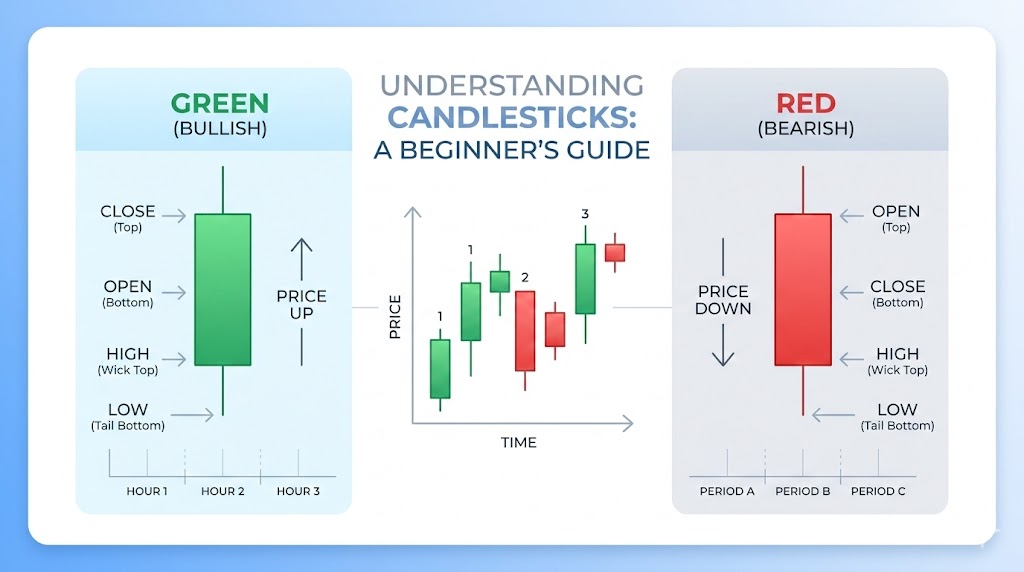
Instead of drawing a single line like older charts, candlesticks display four important pieces of information within one visual shape:
- Opening price
- Closing price
- Highest price reached
- Lowest price reached
Think of each candle as a short summary of market activity during a specific time period.
That period could be:
- 1 minute
- 5 minutes
- 1 hour
- 1 day
- or even 1 week
Each candle tells the story of what happened during that window.
This is why traders prefer candlesticks — they reveal emotion, momentum, and hesitation in ways simple charts cannot.
How Candlestick Charts Work (Without the Confusion)
At first, this sounds confusing. But the structure is surprisingly logical.
Every candle has two main parts:
1. The Body
The thick middle section shows the difference between the opening and closing price.
- Green (or white) candle → price closed higher than it opened
- Red (or black) candle → price closed lower than it opened
In simple terms:
- Green = buyers won that period
- Red = sellers won
2. The Wicks (or Shadows)
The thin lines above and below the body show how far price moved before settling.
These reveal something important: price exploration.
Even if a candle closes green, sellers may have pushed price down earlier. The wick records that struggle.
Understanding this is the first step toward understanding price candles in trading.
Stock Chart Candles Meaning: What a Single Candle Actually Tells You
Many beginners focus on patterns too early. But experienced traders often start with a simpler question:
What is this one candle telling me?
A candle can reveal:
- Strength or weakness
- Buyer confidence
- Seller resistance
- Market hesitation
For example:
- A long green body → strong buying pressure
- A small body → indecision
- A long upper wick → buyers pushed price up but lost control
- A long lower wick → sellers tried pushing lower but failed
It’s less about memorization and more about interpretation.
Imagine watching footprints in sand. You don’t need rules — you just infer what happened.
Reading Trading Charts Basics (The Skill Most Beginners Skip)
Here’s where most people get it wrong.
They jump straight into memorizing candlestick patterns without learning context.
Candles only make sense when viewed alongside:
- Trend direction
- Support and resistance areas
- Market momentum
- Timeframe
A bullish candle inside a downtrend means something very different from the same candle in an uptrend.
Learning the reading trading charts basics first makes everything else easier later.
Candlestick Patterns Explained Simply
Once you understand individual candles, patterns start to feel natural rather than complicated.
A candlestick pattern is simply a repeated behavior between buyers and sellers.
Some beginner-friendly examples:
Hammer
A small body with a long lower wick.
Translation: sellers pushed price down, but buyers strongly reversed it.
Engulfing Candle
One candle completely covers the previous one.
Translation: momentum suddenly shifted.
Doji
Very small body with long wicks.
Translation: indecision — neither side is in control.
Notice something important?
Patterns are not magic signals. They are just visual summaries of market psychology.
This perspective makes candlestick patterns explained simply far easier to grasp.
Beginner Guide to Candlestick Patterns: What Actually Matters
Many guides overwhelm readers with dozens of formations. In reality, beginners only need to recognize a few ideas:
- Rejection — price tried to move but failed
- Momentum — strong directional movement
- Indecision — market uncertainty
- Reversal attempts — potential turning points
If you can recognize those four concepts, you already understand more than most new traders.
Patterns are shortcuts — not guarantees.
How Traders Use Candlestick Charts in Real Life
Professional traders rarely rely on candles alone.
Instead, they combine candlesticks with the basics of technical analysis charts, such as:
- Trendlines
- Support and resistance levels
- Volume
- Market structure
Candles help answer questions like:
- Is momentum increasing?
- Are buyers losing strength?
- Is a reversal likely or just noise?
In other words, candlesticks provide context, not certainty.
Why Candlestick Charts Matter
Markets move because people make decisions — buying, selling, hesitating, reacting to fear or optimism.
Candlesticks visualize that psychology.
Without them, charts show where price moved but not how it moved.
That “how” is often where trading insight lives.
Common Misconceptions Beginners Have
“I need to memorize every pattern.”
You don’t. Understanding behavior matters more than memorization.
“Candlestick patterns predict the future.”
They don’t. They show probabilities based on past behavior.
“One candle equals a trade signal.”
Almost never. Context is everything.
“Experienced traders see secret signals.”
They mostly see structure and repetition — skills developed through observation.
Practical Advice for Learning Faster
If you’re new, try this approach:
1. Watch charts without trading
Spend time observing candles form live.
2. Focus on one timeframe
Switching constantly slows learning.
3. Describe candles in plain language
Example:
“Buyers pushed higher but sellers rejected the move.”
This builds intuition faster than memorizing names.
4. Review past charts
Patterns become obvious when viewed in hindsight.
Realistic Expectations
Learning candlestick charts is not difficult — but it does take exposure.
Most beginners begin recognizing basic behavior within a few weeks of consistent observation.
Mastery, however, comes from seeing thousands of candles over time.
Think of it like learning to read facial expressions. At first everything looks similar; eventually subtle differences become obvious.
FAQ Section
What are candlestick charts in trading used for?
They help traders visualize price movement, momentum, and market sentiment during specific time periods.
Are candlestick charts good for beginners?
Yes. They are one of the most intuitive ways to understand market behavior once you learn what each candle represents.
How long does it take to learn candlestick charts?
Most beginners understand the basics within weeks, but deeper interpretation develops with experience.
Do candlestick patterns always work?
No pattern works all the time. They indicate probability, not certainty.
What timeframe is best for beginners?
Higher timeframes (like 1-hour or daily charts) are usually easier to read because they contain less noise.
Do professional traders really use candlestick charts?
Yes — they are widely used alongside other technical analysis tools.
Thoughtful Conclusion
Candlestick charts aren’t complicated because markets are complicated. They only look complex because you’re seeing compressed information all at once.
Once you realize each candle represents a small story — buyers pushing, sellers reacting, momentum shifting — charts begin to feel surprisingly human.
Start simple. Watch price move. Focus on understanding behavior rather than predicting outcomes.
Over time, the chaos turns into structure.
And that’s when charts stop looking random — and start making sense.