
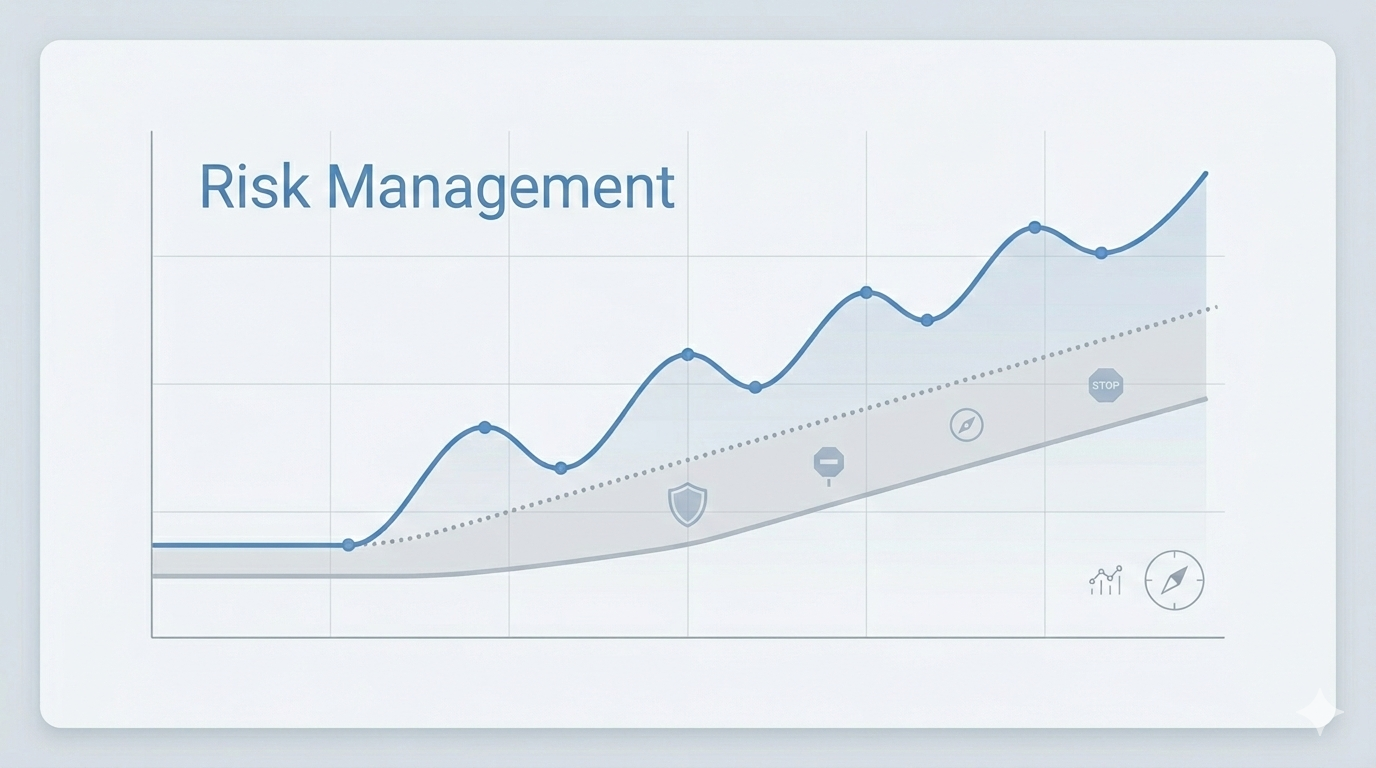
Why Risk Management Matters More Than Strategy
Most people start trading believing one thing:
If I just find the right strategy, I’ll make money.
It sounds logical. After all, every video, forum post, and social media trader seems to talk about entries, indicators, and “winning setups.”
But here’s something many beginners discover the hard way:
strategy alone rarely determines success.
The real difference between traders who survive and traders who disappear often comes down to one skill — risk management in trading.
At first, this sounds confusing. How can managing losses matter more than finding good trades?
Let’s unpack that slowly.
What Is Risk Management in Trading?
In simple terms, risk management is how traders control how much money they can lose on any single trade — and over time.
It answers questions like:
- How much should I risk per trade?
- Where should my stop loss go?
- How do I protect my trading account during losing streaks?
- How do professional traders avoid blowing up?
Many beginners assume risk management is just placing a stop loss. It’s not.
It’s a complete framework that includes:
- position sizing
- risk-to-reward ratio decisions
- account protection rules
- drawdown control
- emotional discipline
Think of it like a seatbelt in a car. You don’t wear it because you expect to crash — you wear it because crashes are inevitable at some point.
Trading works the same way. Losses are not mistakes. They are part of the system.
Why Risk Management Matters More Than Strategy
Here’s where most people get it wrong.
They believe profitability comes from predicting markets correctly.
In reality, trading success is less about prediction and more about survival.
Strategy Determines Entries
Risk Management Determines Longevity
You can have:
- an average strategy + strong risk control → survive and grow
- a great strategy + poor risk control → eventually lose everything
This surprises beginners, but even professional traders lose frequently. What separates them is how small their losses stay.
Imagine two traders:
Trader A
- Wins 60% of trades
- Risks 20% per trade
Trader B
- Wins 40% of trades
- Risks 1% per trade
Trader A feels skilled — until a losing streak wipes out the account. Trader B survives long enough for probability to work in their favor.
Consistency comes from risk, not prediction.
How Traders Actually Manage Risk
Let’s break trading risk management basics into practical parts.
1. Risk Per Trade
A common beginner question is:
“How much should you risk per trade?”
Many experienced traders risk between 0.5%–2% of their account on a single position.
Why so small?
Because losing streaks happen — even with good strategies.
If you risk too much, mathematics works against you quickly.
2. Position Sizing (The Hidden Skill)
Position sizing tells you how large your trade should be based on your stop loss.
Many beginners do the opposite:
They pick trade size first, then hope price behaves.
Professionals calculate risk first, then size the trade accordingly.
This single shift changes everything.
3. Risk-to-Reward Ratio
Risk management also involves balancing potential loss vs potential gain.
Example:
- Risk: $50
- Target: $100
That’s a 1:2 risk-to-reward ratio.
You don’t need to win every trade when winners are larger than losers.
At first, this feels counterintuitive. Beginners often chase high win rates instead of sustainable math.
4. Stop Loss Discipline
A stop loss is not a prediction tool. It’s an account protection tool.
Here’s a hard truth:
Most blown trading accounts didn’t fail because of bad analysis — they failed because traders refused to accept small losses.
Small losses are manageable. Large losses change behavior and decision-making.
Why Beginners Lose Money Without Risk Management
Many beginners experience the same pattern:
- Early wins build confidence
- Position size increases too quickly
- One large loss occurs
- Emotional trading begins
- Account declines rapidly
It’s rarely strategy failure.
It’s uncontrolled risk exposure.
Trading without risk management is like driving fast without brakes. It works — until it suddenly doesn’t.
Strategy vs Risk Management: The Real Difference
A trading strategy answers:
“When should I enter?”
Risk management answers:
“How do I survive when I’m wrong?”
And you will be wrong — often.
Professional traders understand trading as a probability game, not a certainty game.
They focus on:
- capital preservation
- managing drawdowns
- consistent execution
- long-term expectancy
Many beginners spend months searching for indicators when they actually need rules for losses.
Common Misconceptions About Trading Risk
“Good traders don’t lose often.”
False. Good traders lose regularly — just in controlled amounts.
“Risk management limits profits.”
It actually protects profits. Without it, gains are temporary.
“I’ll add risk management after I find a strategy.”
This delays the most important skill. Risk management should come first.
“Small accounts need bigger risk.”
Small accounts need better protection, not bigger bets.
Practical Risk Management Advice for Beginners
If you’re new, start simple.
1. Risk 1% or less per trade
This helps you survive learning mistakes.
2. Decide risk before entering
Never calculate losses after you’re already emotional.
3. Accept losing streaks as normal
Even strong systems experience them.
4. Track drawdowns, not just profits
Consistency matters more than occasional wins.
5. Focus on account survival
Your first goal isn’t making money — it’s staying in the game long enough to learn.
Realistic Expectations About Trading Risk
Here’s something rarely discussed:
Risk management doesn’t make trading exciting.
It makes trading boring.
And boring is good.
Professional trading often feels repetitive and controlled. The dramatic gains seen online usually come with equally dramatic losses hidden behind the scenes.
Risk management replaces emotional highs with steady progress.
That’s how long-term traders operate.
FAQ Section
What is risk management in trading for beginners?
Risk management is the process of limiting how much money you can lose on each trade through position sizing, stop losses, and predefined rules.
Why is risk management more important than strategy?
Because even strong strategies lose sometimes. Risk management prevents those losses from destroying your account.
How much money should I risk per trade?
Many traders risk between 0.5% and 2% of their account per trade, especially when starting.
Can you be profitable with an average strategy but good risk management?
Yes. Controlled losses and consistent execution can outperform high-win strategies with poor risk control.
How does risk management prevent big losses?
It caps downside exposure so no single trade or losing streak can significantly damage your account.
Do professional traders focus more on risk than strategy?
Yes. Professionals prioritize capital preservation and probability management over prediction.
What percentage risk do successful traders use?
Typically small percentages — often 1% or less per trade.
Why do most beginner traders ignore risk management?
Because early education often focuses on entries and indicators rather than long-term survival.
How do you create a simple trading risk plan?
Define risk per trade, set stop losses, calculate position size, and follow rules consistently.
What is the safest way to manage trading risk?
Use small position sizes, predefined exits, and consistent rules regardless of emotions.