How Markets Actually Move
Most people first encounter markets through headlines.
“Markets surge.”
“Stocks tumble.”
“Investors react to news.”
It sounds dramatic — almost mysterious. Prices appear to move because of invisible forces or powerful institutions pulling strings behind the curtain.
Many beginners assume markets move because someone decides they should.
That’s not how it works.
In reality, market movement is both simpler and more fascinating than most explanations suggest. Once you understand how financial markets work, price charts stop looking random. You begin to see a living system made up of decisions, expectations, and constant negotiation between buyers and sellers.
Let’s unpack what’s actually happening.
The Simple Truth: Markets Move Because Trades Happen
At the most basic level, markets move for one reason:
Someone agrees to buy, and someone agrees to sell — at a specific price.
That’s it.
Every tick up or down on a chart represents a transaction. Not news. Not opinions. Not predictions.
A trade.
At first, this sounds confusing. If markets only move because of trades, then why do prices react to news or economic events?
Because news changes how willing people are to buy or sell — not the price itself.
Price changes only when trades occur at new levels.
This idea forms the foundation of the basics of market movement.
How Buyers and Sellers Actually Set Prices
Many people imagine prices being calculated somewhere centrally, like a formula.
In reality, prices are negotiated continuously.
Think of an auction.
- Buyers want the lowest price possible.
- Sellers want the highest price possible.
- The current price is simply where agreement happens right now.
This is how buyers and sellers set prices in every financial market — stocks, currencies, commodities, or crypto.
You’ll often hear terms like:
- bids (what buyers offer)
- asks (what sellers request)
When buyers become more aggressive, price moves up.
When sellers become more aggressive, price moves down.
That’s the entire engine behind how stock markets move.
Supply and Demand — But Not the Way You Learned in School
You’ve probably heard that markets are driven by supply and demand. True — but the classroom version misses something important.
In trading, supply and demand are not static quantities. They are intentions.
A stock might have millions of shares available, yet price can still jump quickly if buyers suddenly compete for limited sell orders at current prices.
This is how supply and demand works in trading:
- More urgent buyers than sellers → price rises.
- More urgent sellers than buyers → price falls.
Notice the word urgent.
Markets react to urgency, not just quantity.
Here’s where most people get it wrong:
They think price moves because more people exist on one side. In reality, price moves because one side is willing to accept worse prices to get filled faster.
What Makes Prices Go Up and Down in Markets
Let’s break this down practically.
Prices change when:
1. Expectations Change
Markets price the future, not the present. Traders constantly adjust positions based on what they think will happen next.
2. Liquidity Changes
When fewer orders exist near the current price, even small trades can cause large moves.
3. Large Participants Enter or Exit
Institutional traders place orders large enough to shift available supply.
4. Emotion Spreads
Fear and optimism create waves of buying or selling pressure.
These forces combine to explain what drives stock market changes on a daily basis.
Who Actually Moves Market Prices?
A common beginner question is: who moves the market prices?
The surprising answer:
Everyone — but not equally.
Markets are made up of different participants:
- individual traders
- hedge funds
- pension funds
- banks
- algorithmic trading systems
- market makers
Retail traders contribute activity, but large institutions often create sustained trends simply because of the size of their orders.
Still, no single entity controls prices long-term. Markets are competitive environments where thousands of decisions collide every second.
Why Markets Rise and Fall (Even Without News)
Many beginners watch markets waiting for explanations.
Sometimes prices move sharply with no obvious reason.
This feels irrational — but it isn’t.
Here’s why markets rise and fall:
- Positions are being adjusted.
- Risk is being reduced or increased.
- Large orders are being executed gradually.
- Traders react to other traders.
News often explains moves after they happen, not before.
In fact, markets frequently move before major news becomes widely understood because expectations shift early among informed participants.
How Trading Actually Affects Prices
Every order interacts with existing orders.
Imagine a ladder of prices:
- Sellers waiting above
- Buyers waiting below
When a buyer aggressively purchases shares at higher levels, they remove available sell orders. The next available seller sits at a higher price — so the market moves up.
This is how trading affects prices in real time.
Charts are not abstract patterns. They are footprints of executed orders.
Once you start seeing charts this way, price action becomes less mysterious and more logical.
Market Movement Explained Simply
If we compress everything into one idea:
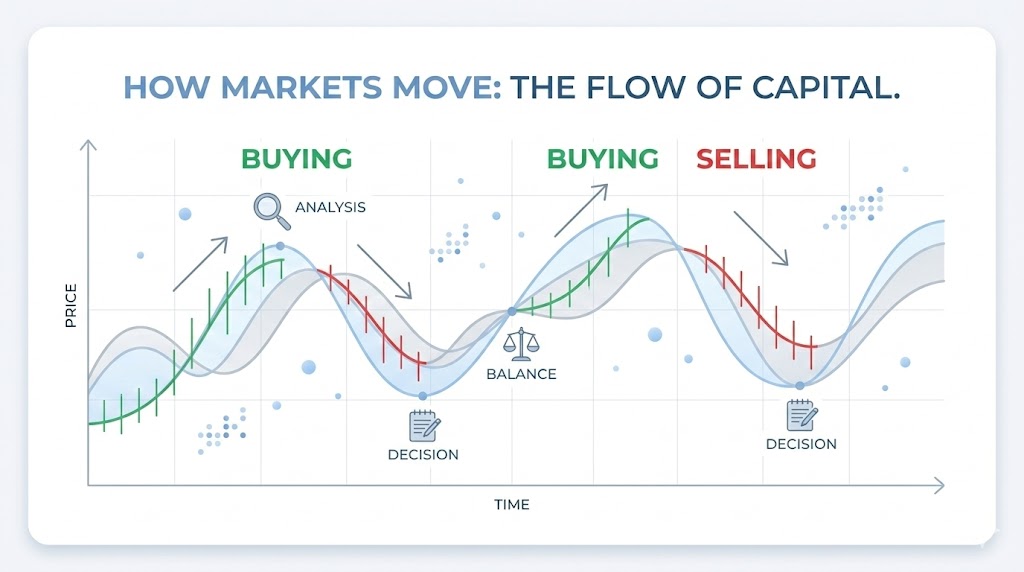
Markets move when imbalance appears between buyers and sellers.
That imbalance can come from:
- new information
- changing expectations
- risk management
- emotion
- liquidity conditions
Price moves until balance is temporarily restored.
Then the process repeats — endlessly.
That’s market movement explained simply.
Common Misconceptions Beginners Have
“News moves markets.”
News influences decisions. Trades move markets.
“Smart traders predict price.”
Most professionals react to changing conditions rather than predicting perfectly.
“The market is manipulated constantly.”
Short-term distortions exist, but long-term prices reflect collective decisions.
“Indicators cause movement.”
Indicators describe past behavior; they don’t create buying or selling.
Many beginners spend years studying tools before understanding the mechanism underneath them.
Why Understanding Market Movement Matters
Learning how financial markets work changes how you approach trading and investing.
You stop asking:
- What indicator should I use?
And start asking:
- Where is pressure coming from?
- Who might need to buy or sell next?
- What imbalance exists right now?
This shift moves you from guessing to reasoning.
Practical Advice for Beginners
If you’re trying to understand markets more deeply:
Focus on Mechanics First
Understand orders, liquidity, and participation before strategies.
Watch Price Behavior, Not Predictions
Observe how markets react rather than forecasting constantly.
Accept Uncertainty
Markets are probabilistic systems, not machines with fixed outputs.
Study Reactions
How price responds to events matters more than the events themselves.
Realistic Expectations
Understanding markets does not make movement predictable.
It makes it interpretable.
Even experienced traders cannot control outcomes. What they gain is context — a clearer understanding of why prices behave the way they do.
Markets remain complex because humans remain complex.
And that’s exactly why opportunities exist.
FAQ Section
Why do financial markets move every day?
Markets move because buyers and sellers continuously agree on new prices as expectations and risk perceptions change.
What is the main force behind price movement?
An imbalance between buying pressure and selling pressure.
Do retail traders move markets?
Individually, rarely. Collectively, they contribute liquidity and momentum.
Why do prices move without news?
Institutional positioning, liquidity shifts, and expectation changes often occur independently of headlines.
How does supply and demand affect trading?
Price moves toward levels where supply and demand temporarily balance through executed trades.
Are markets random?
Not random — but complex and influenced by many interacting decisions.
Can one trader control the market?
No single participant controls large markets over time.
Why do markets sometimes move fast?
Low liquidity or aggressive orders can cause rapid price adjustments.
Is understanding market mechanics important for investors too?
Yes. It helps investors interpret volatility and avoid emotional decisions.
What should beginners learn first?
How buyers and sellers interact to create price movement.