
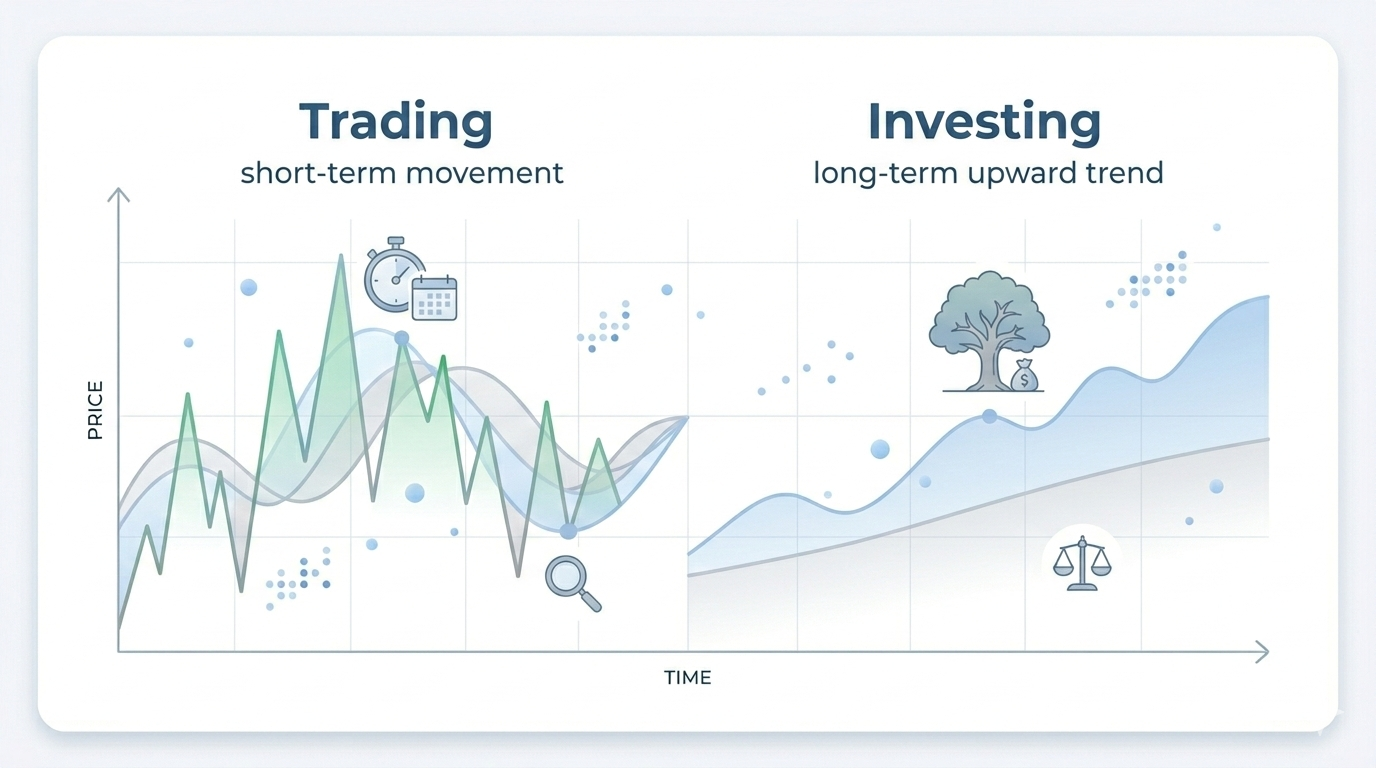
Trading vs Investing: What Beginners Should Know
If you’ve ever looked into the stock market, you’ve probably run into the same question almost immediately:
Should I start trading or investing?
At first glance, they seem like the same thing. Both involve buying assets, both aim to grow money, and both happen inside the same markets. Many beginners assume trading and investing are simply different words for making money in stocks.
They aren’t.
Understanding trading vs investing early can save you from unrealistic expectations, unnecessary risk, and a lot of frustration. The truth is, these approaches require different mindsets, time commitments, and even personalities.
Let’s break it down in plain language.
The Basics of Trading and Investing
Before comparing them, it helps to understand what each one actually means.
Investing (The Long-Term Approach)
Investing focuses on building wealth gradually over time. Investors typically buy assets — stocks, ETFs, or funds — and hold them for years or even decades.
The idea is simple:
- Businesses grow
- Earnings compound
- Markets trend upward over long periods
Investors rely less on daily price movements and more on long-term economic growth.
Think of investing like planting a tree. You water it occasionally, give it time, and allow growth to happen naturally.
Trading (The Short-Term Approach)
Trading, on the other hand, focuses on short-term price movements.
Traders buy and sell more frequently — sometimes within days, hours, or even minutes — trying to profit from market fluctuations.
Instead of asking:
“Will this company grow over 10 years?”
Traders ask:
“Where might the price move next?”
It’s closer to active decision-making than passive wealth building.
A useful analogy: investing is owning a rental property for decades, while trading is flipping houses repeatedly.
The Difference Between Trading and Investing
Here’s where most people get it wrong: they assume trading is just “faster investing.”
In reality, they operate on different principles.
| Investing | Trading |
|---|---|
| Long-term focus | Short-term focus |
| Lower activity | Frequent decisions |
| Compounding returns | Price movement profits |
| Research fundamentals | Analyze price behavior |
| Often passive | Highly active |
Understanding how trading is different from investing helps clarify why beginners often struggle when they start with the wrong expectations.
Long-Term Investing vs Short-Term Trading
The biggest contrast comes down to time horizon.
Long-Term Investing
- Months to decades
- Less daily monitoring
- Benefits from compounding
- Emotionally calmer (most of the time)
Short-Term Trading
- Minutes to weeks
- Requires regular attention
- Sensitive to volatility
- Emotionally demanding
Many people underestimate how much time trading actually requires. Watching markets regularly isn’t optional — it’s part of the strategy.
Why This Difference Matters for Beginners
When people search trading vs investing for beginners, they’re usually asking something deeper:
“Which one gives me the best chance of success?”
The answer depends less on intelligence and more on lifestyle and expectations.
Many beginners assume trading produces quick income. Social media often reinforces this idea. But short-term trading introduces challenges beginners rarely anticipate:
- emotional pressure
- rapid decision-making
- inconsistent results early on
Investing, meanwhile, feels slower — almost boring — yet historically aligns better with long-term wealth building.
That’s why understanding the basics of trading and investing matters before you risk real money.
Is Trading Riskier Than Investing?
This question comes up constantly, and the honest answer is nuanced.
Yes — trading is generally riskier than investing, especially for beginners.
Not because trading is inherently bad, but because:
- decisions happen faster
- mistakes compound quickly
- emotions play a larger role
- costs and timing matter more
Investors can survive temporary market declines because time works in their favor. Traders rely on accuracy and discipline from the start.
At first, this sounds confusing. After all, both involve risk. The difference is how forgiving each approach is.
Investing gives you time to recover from mistakes. Trading often doesn’t.
Trading vs Investing Pros and Cons
Both approaches have legitimate advantages.
Investing — Pros
- Simpler strategy
- Less time required
- Compounding growth
- Lower stress for most people
Investing — Cons
- Slower results
- Requires patience
- Market downturns test discipline
Trading — Pros
- Potential for quicker gains
- Active engagement
- Skill-based improvement over time
Trading — Cons
- Steeper learning curve
- Emotional strain
- Higher probability of beginner losses
There isn’t a universal winner — only a better fit for your goals.
Trading or Investing: Which Is Better?
This is the wrong question — but an understandable one.
A better question is:
Which approach matches your situation right now?
Consider these factors:
| If you… | You may prefer… |
|---|---|
| Have limited time daily | Investing |
| Enjoy analysis and fast decisions | Trading |
| Want long-term wealth | Investing |
| Want active market involvement | Trading |
| Are learning financial basics | Investing first |
Many experienced market participants eventually do both — investing for long-term growth while trading with a smaller portion of capital.
Common Beginner Misconceptions
1. “Trading makes money faster”
Sometimes — but consistency is much harder than it appears.
2. “Investing requires a lot of money”
Not anymore. Many platforms allow small starting amounts.
3. “You must choose one forever”
You don’t. Your strategy can evolve.
4. “Trading is just buying and selling quickly”
Successful trading involves structured risk management and planning.
Practical Advice for Beginners
If you’re still asking should I trade or invest as a beginner, here’s a realistic starting framework:
- Start by learning investing principles first.
Understanding markets long-term builds foundational knowledge. - Focus on risk before profit.
Protecting capital matters more than chasing returns. - Observe markets before actively trading.
Many beginners rush into activity without understanding price behavior. - Treat learning as part of the investment.
Education compounds just like money does. - Keep expectations realistic.
Progress happens slower than online success stories suggest.
Realistic Expectations: What Beginners Should Know
Here’s an honest observation: both trading and investing involve periods of doubt.
Markets don’t reward impatience. Even experienced participants face uncertainty regularly.
Investing often feels uneventful — until years pass and growth becomes noticeable.
Trading feels exciting — until discipline becomes the real challenge.
Neither path is easy. But both can be valuable when approached with realistic expectations.
FAQ Section
What is the difference between trading and investing?
Investing focuses on long-term asset growth, while trading aims to profit from short-term price movements through frequent buying and selling.
Is trading better than investing for beginners?
For most beginners, investing is easier to start because it requires fewer decisions and less constant monitoring.
Can you do both trading and investing?
Yes. Many people invest for long-term goals while trading a smaller portion of their portfolio.
Is trading riskier than investing?
Generally yes, especially for beginners, because trading depends heavily on timing and short-term accuracy.
How much money do you need to start investing or trading?
Both can be started with small amounts today, though trading often requires stricter risk management due to frequent transactions.
Should I learn investing before trading?
Learning investing first helps beginners understand markets, risk, and long-term behavior before attempting short-term strategies.
Thoughtful Conclusion
The debate around trading vs investing isn’t really about which method wins.
It’s about understanding how you want to participate in markets.
Investing rewards patience and consistency. Trading rewards discipline and skill development. Both require learning, humility, and time.
If you’re just starting, focus less on speed and more on understanding. Markets will always be there — and the goal isn’t to move fast, but to move wisely.